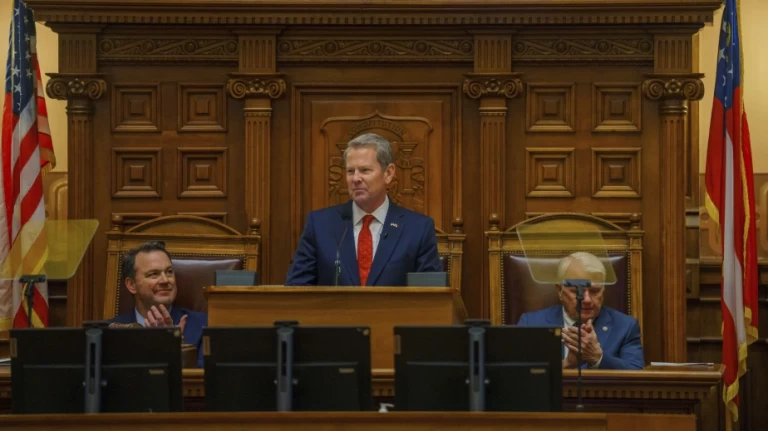
Atlanta, May 14, 2026 – Gov. Brian Kemp signed a proclamation calling the Georgia General Assembly into a special legislative session beginning June 17, 2026, directing lawmakers to redraw the state’s congressional, state Senate, and state House district maps. The announcement follows last month’s 6–3 U.S. Supreme Court ruling in Louisiana v. Callais that weakened the Voting Rights Act’s protections against racially discriminatory redistricting — a decision that has set off a wave of map-redrawing efforts across Southern states.
“Voting is already underway for the 2026 elections, but it’s clear that Callais requires Georgia to adopt new electoral maps before the 2028 election cycle,” Kemp said. He has ruled out any changes for this November’s races, as candidates have already qualified, primaries are underway, and ballots have been prepared. Any redrawn maps take effect starting in 2028.
Ramifications of The Supreme Court Ruling
The catalyst is the Court’s April 29 decision in Louisiana v. Callais, authored by Justice Samuel Alito. The 6–3 ruling found that Louisiana’s second majority-Black congressional district — created under pressure to comply with the Voting Rights Act — was itself an unconstitutional racial gerrymander.
“Section 2 of the Voting Rights Act was designed to enforce the Constitution — not collide with it.” — Justice Samuel Alito, majority opinion
Critics, including the NAACP Legal Defense Fund, called it one of the most damaging blows to voting rights protections in a generation, arguing it allows states to use partisan gerrymandering as cover for diluting minority voting power. Alabama and Tennessee moved swiftly after the decision; Georgia is now following suit on a longer timeline.
A Second Urgent Issue – Ballot QR Codes
Redistricting is not the only item on the June agenda. Lawmakers also face a looming crisis over Georgia’s voting machines. A 2024 state law bans the use of QR codes to tally votes after July 1, 2026 — but counties still rely on the same machines, and the legislature never funded statewide replacements. A bipartisan House bill proposing a delay until 2028 failed to advance in the Senate. Without action, Georgia’s election infrastructure faces a legal conflict heading into November.
Political Reaction Divided Along Party Lines
Republicans praised the move, with Kemp framing Callais as a ruling that “restores fairness to our redistricting process.” Democrats responded sharply. The Georgia Democratic Party called it “typical Republican behavior,” saying: “When they can’t win with voters, they rewrite the rules to benefit themselves.” Senate Minority Leader Harold Jones of Augusta added: “If Republicans ever used their power to help Georgians, they wouldn’t have to waste time and money redrawing the maps every few years to keep their majorities.”
Democrats also noted the strategic timing: the session opens the day after June 16 primary runoffs, ensuring a Republican governor is in place to sign whatever maps the GOP-controlled legislature produces.
Impact On AAP Community In Georgia
Georgia’s Asian American and Pacific Islander population has grown dramatically over the past two decades, with large concentrations in Gwinnett, DeKalb, Fulton, and Forsyth counties. How district lines are drawn directly shapes whether AAPI voters are concentrated into a single district — amplifying their collective voice — or split across multiple districts in ways that dilute it.
Community advocates note that the Callais ruling may also weaken the legal tools historically used to challenge maps that minimize minority representation. No proposed maps have been made public as of this reporting. Advocacy organizations, including the Asian American Advocacy Fund, are expected to monitor the special session closely and engage the redistricting process on behalf of Georgia’s diverse communities.