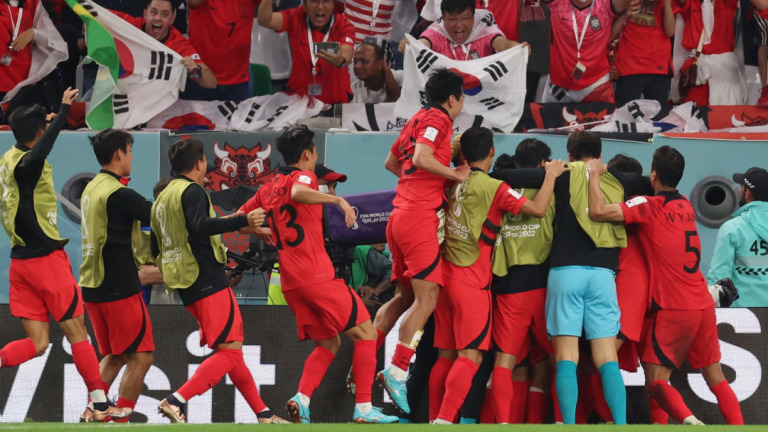
Seoul, June 28, 2026 – South Korea's national men's football team was eliminated from the 2026 FIFA World Cup on Sunday after failing to advance past the group stage and the fallout was swift, reaching all the way to the presidential office in Seoul.
The Taegeuk Warriors' exit was confirmed at Mercedes-Benz Stadium in Atlanta, where DR Congo defeated Uzbekistan 3-1 in the final Group K match, pushing South Korea out of the top eight third-place teams needed to advance to the Round of 32.
The elimination was particularly bitter. South Korea finished third in Group A with three points, one win over the Czech Republic, followed by back-to-back losses to host nation Mexico and South Africa. Under the tournament's expanded 48-team format, the eight best third-place finishers qualify for the knockout round. South Korea ultimately ranked 10th, falling two spots short.
THE SON DECISION
The turning point came Wednesday in Monterrey, when Coach Hong Myung-bo made the stunning choice to bench captain and star forward Son Heung-min against South Africa, the first time in Son's international career he was left out of the starting lineup. South Africa won 1-0, stripping Korea of control over its own fate.
Hong's plan, he later explained, was to bring Son on in the second half to exploit fatigued South African defenders. The strategy failed. South Africa manager Hugo Broos said afterward his side had been “better tactically” and that Korea's style of play had been “predictable.”
Former KBS commentator and ex-national team defender Lee Young-pyo did not mince words, calling the South Africa match “the worst by a Korean football team in the 21st century” and adding, “there was no structure, no objective, and it was hard to understand why the players were even running.”
PRESIDENT LEE DEMANDS ACCOUNTABILITY
President Lee Jae-myung moved quickly. Hours after elimination was confirmed, he publicly blamed “organizational and personnel failures” and directed the Ministry of Culture, Sports and Tourism to conduct a thorough investigation and prepare measures to prevent a recurrence.
“Because a significant amount of taxpayer money and national resources are invested in World Cup participation, I ask that the ministry thoroughly examine the exact circumstances and causes of this incident,” Lee said.
The president also signaled broader governance reforms at the Korea Football Association, pushing for leadership selection to shift from closed executive-committee voting to direct democratic processes open to all stakeholders in the sport.
The KFA has faced scrutiny for years over opaque coaching appointments. Hong's 2024 hiring bypassed standard interviews and presentations and his annual salary of 3.8 billion won was later revealed to be more than double that of Japan's coach Hajime Moriyasu.
FURY AT HOME AND ABROAD
Reaction in South Korea was immediate and furious. Ruling Democratic Party lawmaker Rep. Song Young-gil labeled the KFA “the greatest enemy of Korean football,” pointing to what he called years of cartel-like elitism and weak accountability. Actor Han Jung-soo targeted KFA chairman Chung Mong-gyu on social media, calling him “the real culprit.” Comedian Lee Kyung Kyu, in a live stream, called it “the worst World Cup” he had followed since 1994.
A viral behind the scenes clip added fuel to the fire, showing Hong presenting a pre-match tactical slide to the squad bearing a single word in English: “FIGHT.”
The KFA announced that no welcome ceremony would be held for the returning team at Incheon International Airport, the first time in six away World Cups since 2002 that the association has not held any homecoming event.
LOCAL CONNECTION
For Atlanta's large Korean-American community centered in Gwinnett County's Duluth and Suwanee corridors and along Buford Highway, the elimination carried a painful geographic irony. South Korea's fate was sealed right here, inside Mercedes-Benz Stadium, during a match between two other nations.
South Korea has now appeared in 12 World Cups. The team reached the semifinals as co-host in 2002, and the Round of 16 in both 2010 and 2022. This marks the earliest exit in the modern era of Korean football.