Doraville, October 7, 2026 – A short drive from the Buford Highway shops and restaurants that anchor much of metro Atlanta’s Asian American community, the two candidates for governor stood on the same stage Tuesday night and took questions not from journalists, but from undecided Georgians.
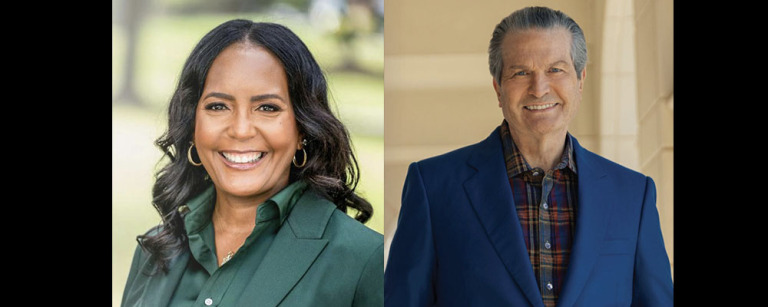
Democrat Keisha Lance Bottoms and Republican Rick Jackson met in Doraville for their only televised debate, a one-hour town hall hosted by Atlanta News First at Assembly Studios. Under the format, the candidates could not address each other directly and answered only voters’ questions. The voters came from across the state: a single mother from Cobb County, a Marine veteran from Cherokee, a special-needs parent from Columbia County, a poll manager, a rural resident worried about her water supply.
Paychecks and taxes
Asked how working families can survive on Georgia’s $7.25 minimum wage, Jackson pointed to job creation and workforce training rather than a wage increase. He said students should be exposed to trades early, since those jobs pay at least $25 an hour plus benefits. “I don’t know about you, but my plumber drives a Mercedes,” he said later in the evening.
Bottoms drew on her own upbringing, describing a single mother who worked and attended cosmetology school at night. Noting that she raised city workers’ pay to $15 an hour as mayor, she said “that living wage should be applied across the state.” She also called for free technical and community college.
On taxes, Jackson said property taxes rose 49% in recent years, “which is completely insane,” and promised to freeze and then reduce them while cutting the income tax. Bottoms proposed raising average teacher pay from about $43,000 to $60,000, eliminating income taxes for teachers and fully funding pre-K.
Health care: an unexpected agreement
Both candidates said they would expand Medicaid. Bottoms called it “a day one priority for me as governor” and accused Jackson, whose fortune comes from health care staffing, of profiting from a broken system. Jackson said he would expand coverage “to cover everybody” while protecting the $4.5 billion in federal funding the state currently receives.
On insurance denials, the two again sounded similar. “I absolutely will be insurance companies’ biggest nightmare,” Jackson said. Bottoms said repeat offenders should not be allowed to do business in Georgia, and added that patients should be told when AI is used to deny claims and be able to appeal to a human being.
The sharpest clash: data centers
A Lee County voter’s question about data centers and eminent domain produced the night’s most heated exchange. Jackson said he would not approve a project unless the community approves it, it meets strict environmental standards, and residents see lower power bills and property taxes. Bottoms called for a pause on new construction and said Jackson’s investments in data center companies mean “he cannot be trusted on this.”
Jackson denied owning or investing in data centers and accused Bottoms of granting $400 million in tax benefits for one in Atlanta. “You are what your record says you are, not what you say you’re going to do,” he said. Bottoms replied that the project at Georgia Tech was only 15% of a larger development, not a hyperscale facility, and brought 4,200 jobs to the city.
Surveillance cameras
Two questions focused on license plate readers such as Flock cameras, which our community has watched spread through metro Atlanta. “The technology has gotten ahead of the policy,” Bottoms said, calling for search warrants, audited access logs, limits on retention and criminal penalties for misuse. She supports a moratorium on installing new cameras, though not on existing ones. Jackson agreed privacy safeguards are needed but opposed a moratorium, saying he did not want crime to rise.
Trump, Kemp and the election
When a DeKalb County voter who lost a federally funded job asked about the cuts, Bottoms tied Jackson to the president. “I’m not running to be his favorite governor,” she said. “I’m running to work on behalf of people like you.”
Jackson did not mention Trump by name. “I will stand up to anybody, just like Brian Kemp has done,” he said. On election security, he praised Kemp’s 2021 voting law and said he saw no need for the Justice Department to get involved in Georgia’s elections. Bottoms promoted her proposed Johnson Lewis Voting Rights Act, which would make Election Day a state holiday and expand voting hours. “The right to vote is sacred,” she said.
The night ended on a tense note. Bottoms said Jackson had promised to call in the National Guard during the election. Jackson called it “a complete falsehood” and said he wanted to be “a uniter, not a divider.” Bottoms held her ground: “You all can pull the tape on that.”
A race too close to call
Neither candidate landed a knockout blow. Heading into the debate, an InsiderAdvantage poll had Jackson at 48% and Bottoms at 46%, with 6% undecided, while FiftyPlusOne’s average as of Oct. 6 shows Bottoms ahead, 48.4% to 44.9%.
A rematch is unlikely. Jackson declined the Atlanta Press Club debate on Oct. 12, where Bottoms will appear alongside an empty podium.
Voters’ checklist
Registration closed Oct. 5. Early voting runs Oct. 13 through Oct. 30, and the last day to request an absentee ballot is Oct. 23. Election Day is Tuesday, Nov. 3. Check your county elections office or Georgia’s My Voter Page for early voting locations and hours.