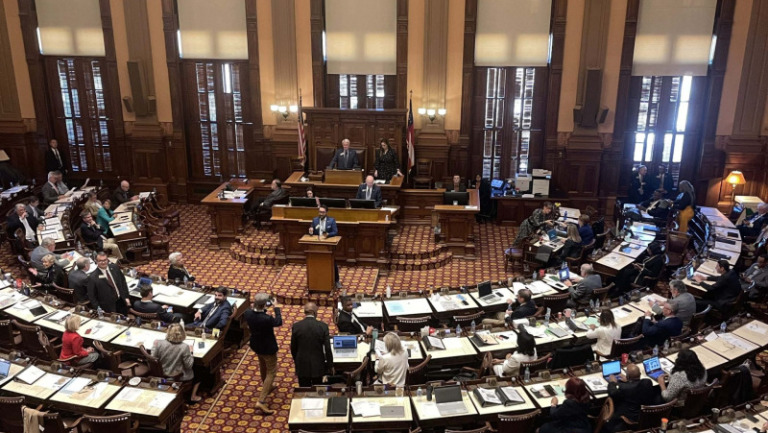
Atlanta, June 17, 2026 — Georgia’s Republican-controlled legislature gaveled in today for its redistricting special session, but GOP leaders arrived without a public draft of new maps, leaving even some of their own caucus uncertain who is actually drawing the lines.
Gov. Brian Kemp, who called the session, declined to preview details beforehand. “I’ll talk about redistricting on Wednesday,” he told reporters while campaigning for fellow Republicans ahead of Tuesday’s primary runoffs. House Speaker Pro Tem Jan Jones, a senior Republican on the committee expected to handle new maps, said the final product would be left to legislative leadership to decide, but acknowledged she hadn’t personally seen any draft plans and didn’t know who was drawing them.
Georgia GOP Chairman Josh McKoon has been the party’s most vocal advocate for aggressive action, arguing new maps should be “rooted in traditional, race-neutral principles,” such as compactness and respect for county lines, rather than racial considerations. Lt. Gov. Burt Jones, who has positioned himself as a champion of the redistricting push, praised the Supreme Court’s Callais ruling that opened the door to it, saying at the time, “The Supreme Court made the right decision today.”
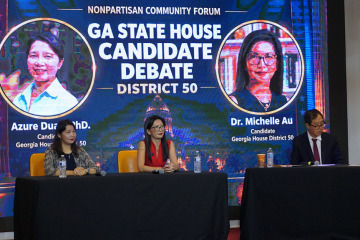
Rep. Sam Park (D-Lawrenceville), the first Asian American Democrat elected to the Georgia legislature, told a Korean American community gathering in May that redistricting could set back the political progress of minority communities by 10 to 20 years. Park argued the state’s resources would be better spent investing directly in communities like Korean Americans rather than redrawing lines that could fragment their voting strength, and he cautioned that communities of color risk being systematically diluted through mapmaking tactics commonly known as packing and cracking.
Rep. Marvin Lim (D-Norcross), the first Filipino American elected to the Georgia House, struck a more pragmatic tone at a Duluth town hall. Lim acknowledged that Democrats plan to put forward their own alternative maps, but said the Republican majority ultimately controls which bills advance. He urged AAPI voters to call legislative offices directly rather than email, noting that most of his colleagues rarely check their inboxes.
Rep. Saira Draper (D-Atlanta), a member of the legislature’s AAPI Caucus and an election attorney, pushed back directly on Gov. Brian Kemp’s justification for the session. She said Kemp’s claim that the Callais ruling requires Georgia to redraw its maps “couldn’t be further from the truth,” noting that whether the state’s current districts remain discriminatory under the new legal standard is still an open legal question being litigated before the 11th Circuit.
Republicans emphasize the new maps won’t affect this year’s midterms, taking effect only for 2028. But the lack of transparency about who is drafting them, and how far Republicans intend to go, has fueled speculation about how aggressively metro Atlanta’s diverse districts including those with significant AAPI populations in Gwinnett and Forsyth counties could be redrawn once a plan finally surfaces.